The day we caught the train: Interrailing to Innsbruck, Capital of the Alps

Updated: Oct 30, 2025

It all began one May evening as we sat watching the TV programme, Race Across the World. The kids were hooked on the adventures of the competing pairs as they attempted to navigate their way across the impossibly exotic landscapes of China, Nepal and India. The daily decisions to be made on itinerary and budget, the mix of privation and wonder, the time spent together, and by and large, all on public transport. The allure of travel – wanderlust – was upon us as a family and we knew that this summer holiday would be like no other.
We already had a loose idea of mountains, forests and things Germanic, but the eureka moment came the following morning when I woke abruptly, turned to my wife and declared, ‘I think we should go my train. Let’s go interrailing.’
‘Isn’t that something you do when you’re 18?’ came the reply. But the plan was already forming for both of us.
It turns out things have changed in the last 28 years. Interrail Passes, available through the excellent Rail Europe, can be used by anyone and cover all train routes in Europe. You simply decide how many travel days you want to use in a month, buy your pass and then activate it on the first and for each subsequent day of travel at the mere touch of a button. For some of the major intercity routes, it is necessary to purchase a seat reservation, but this is typically a nominal fee if you avoid peak times. While there is still a charge for the Eurostar, you get a hefty discount with an interrail pass, again if you choose your timings wisely. Everything, of course, is marshalled through the Rail Planner App. When we discovered that children under the age of 11 go free, it was, shall we say, a fait accompli.
But where to? I had in mind Paul Theroux's The Great Railway Bazaar, his brilliantly eccentric train odyssey through Europe and Asia; we had only recently watched Agatha Christie’ Murder on the Orient Express. In the end it was that train travel almanac, Man in Seat 61, which finally showed us the way. Years ago, my father would take me on the Bluebell Railway in East Sussex, a nostalgic steam engine ride in the grand style of the early 1900s. So, when I came across the ‘scenic route’ of the Arlberg Pass, one of the three great trans-continental routes of the Orient Express, I knew we had found our passage across Europe.
The destination stared out at us from the map: Innsbruck, Capital of the Alps.
So it was that early one morning in late July, four backpacking turtles closed our front door and padded down to the Metropolitan Line at the end of the road.
Under the blue haze of the wrought iron roof of St Pancras International, my seven-year-old son and nine-year-old daughter began to express their fearful curiosity of going under the sea on the Eurostar.
‘Will we be able to see underwater?’
‘Will we have to hold our breath?’
But before you could say Jules Vernes, we were seeing cars driving on the wrong side of the road and the vasty fields of France.

‘Paris smells,’ remarked my daughter as we passed the public loos between the Gare du Nord and the Gare de l’Est. It was also rather beautiful, as she sketched the Eiffel Tower, the Dame de Fer dressed in her latticed iron lingerie, in the four hours we had between trains. And there is still a vestige of the golden age of travel in that glass of beer sitting outside the gleaming station brasserie while the train, which in half an hour will whisk you across France, lies purring at the platform.
Feeling yet more glamorous on the top floor of a double-decker Train de Grand Vitesse set for Strasbourg, we toasted our success as a family for making our first major connection. “Prost!” became a little ritual ceremony each time we made our train, a celebration of our undoubted European savoir-faire. But once we were clear of the Parisian banlieues, a strange thought occurred.
The TGV is monstrous. Wondrous yet monstrous.
Could it be just too fast?
For someone who has spent far too much of his life on rail-replacement buses in the south of England, I was aware of the laughable irony behind such a question. Be that as it may, I found myself gripping the arm rests like a country mouse, seeing the languorous fields and villages of his quotidian reduced to mere vignette. Like a moth to a flame, tours of the train brought one’s nose to the window of the ground floor and less than a baguette’s distance from a blur of railway track sweeping past at 320 km/h.
For a moment I was Tess from Thomas Hardy’s Tess of the d’Urbervilles, that figure caught between a changing and disappearing rural way of life at the end of the 19th Century and the ache for the modern:
The light of the engine flashed for a second upon Tess Durbeyfield's figure, motionless under the great holly tree. No object could have looked more foreign to the gleaming cranks and wheels than this unsophisticated girl, with the round bare arms, the rainy face and hair, the suspended attitude of a friendly leopard at pause, the print gown of no date or fashion, and the cotton bonnet drooping on her brow… Tess was so receptive that the few minutes of contact with the whirl of material progress lingered in her thought…
In was in a such a whirl that we came to Strasbourg where to arrive is to set foot in the vitreous world of the uber modern. An enormous concave shield of glass curves over the front of the grand old station to create a gleaming forecourt, which in the evening acts like an x-ray to reveal the bones of the original structure. Strasbourg is Europe’s Hauptbahnhof, anathema to Brexiteers as the elegant seat of the European Parliament.
It is also prefecture of the Alsace region, that linguistic and cultural melange of France and Germany created by successive wars since the seventeenth century. As we dined that evening among the canals and cross-timbered buildings of the Petite France district, our very dishes were reminders of a city whose history has been as fluid as my daughter’s bowl of onion soup made with the sweet onions of the Rhineland, as hybrid as my Coq au Reisling and as self-possessed as my son’s Bavarian pork knuckle. What hasn’t changed is the Gothic cathedral at the heart of the old town, whose towering façade of biblical story and instruction has lost none of its awesome power almost 600 years later.

From Strasbourg we felt like our European way of life by train had really begun. Time travelled faster than anticipated and not once did the kids complain of being bored. Not one of mention of the life-sapping declaration, ‘I don’t know what to do’, because there was always something to do – writing journals, reading, playing cards, mastering the art of crotchet, eating freshly baked station croissant, the obligatory tours of the train to the buffet car and back, eavesdropping on snatches of foreign tongues, or simply gazing out of the window. The beauty of the idle hour. No screens. Simply being, really, in motion. You would never choose inter-railing if you wanted the carefreeness of the package holiday, but the downtime of train travel is uniquely satisfying. Whatever you are doing – or not doing – you are still on the move.
It was an easy hop and a skip through Switzerland. Yet it was on the train from Basel to Zurich that I very nearly fell foul of Swiss punctiliousness. To my chagrin and the acute embarrassment of the kids, I discovered that I had only activated my interrail pass for the trip and not those of the rest of family. I did my best to explain to the glowering lady conductor that it was my technological naivety and not a criminal mind that was to blame. But she kept me waiting, while she consulted and weighed the scales. The tension mounted. We exchanged anxious looks. It could have been 1941 and ‘Documents please!’. Finally, she relented. ‘I will accept this reason,’ came the emotionless response, perfected by a century of neutrality. But a knowing look from my wife told me we had narrowly escaped with our freedom as we pulled into the station.
We had budgeted for a mere three hours in Zurich and its patina of wealth, where arguably the best thing to do between trains is to take a swim in the lake that fronts the entire city. Old fashioned swim lidos are dotted around Zurichsee, and for a modest entrance free, you gain access to one of these platforms built over the fringe of the lake. As you change in simple cabins, the water laps promisingly beneath the slats under your feet. In deckchairs, locals sunbathe and drink beer post swim. There are separate men and women areas for those seeking sequestration in their gender and there is a definite Hampstead Heath swimming ponds vibe going on.
A water-level perspective is a fine way to get an impression of the quality of life enjoyed by the Swiss. With their elegant cities courted by forested hills, clear alpine lakes and mountains ranging further off in cool reserve, you can see why they are happy with their lot. But we were on the cuckoo clock. Our connecting train was leaving within the hour. Though not before my son had dared me to dive from the 5m board thrusting out over the lake. Thus I found myself climbing the rungs of what looked like a 1930s diving platform and stepping out onto a wobblingly precarious plank. I felt dizzy, self-conscious, nervous. Zurich looked on.
‘Make sure you go forwards, not to the side,’ advised the lifeguard on duty. ‘They wouldn’t build them like this nowadays.’
That didn’t exactly help. But I took the plunge and disappeared deep into Switzerland. Only to surface on the Railjet Express to Innsbruck.
The railway journey from Switzerland to Austria must surely be one of the most beautiful in Europe, a classic of its type. And before you ask, the speed is just so. The journey East begins by clinging to the southern shore of Zurichsee, passing by the eminently habitable homes of Kilchberg and Horgen, the track on occasion laid so close to the water that from the window of the train you have the impression of a spectacular infinity pool rising to meet your family game of cards. Closer to the border, Walensee is altogether more untamed; sheer cliffs drop to the water level and we see a lone windsurfer braving the waves.
As the eye travels upwards to the hills, the undulating dark green of the forests are cut with swathes of bright green grassland. Here you will find the Switzerland of popular imagination, the houses of alpine villages spread out comfortably on a carpet of lustrous green. We stopped briefly at the border town of Buchs, where the train changes direction into reverse. It’s then a 20-minute jaunt across Liechtenstein, that mountainous prelude to arrival in Austria and loveliest of journeys, the Arlberg Pass.
Completed in 1864, The Arlberg Railway is one of the highest standard gauge tracks in Europe. The eponymous Arlberg Orient Express, taking passengers from London to Bucharest, was one of the three parallel routes traversing the continent in the luxury of a more genteel age. The closest you can get to replicating that journey now is by taking the Paris to Budapest sleeper train, but really this is a journey you want to do by day. The views as you travel up the glacial valley of the river Inn towards Innsbruck in the northern Tyrol are stupendous.
It’s a journey that makes you fall back in love with trains and travel; this is the moment to head for the plush seats and panoramic windows of the restaurant car which sits between first and second class, order your first schnitzel and mini bottle of Austrian red (or spezi orange cola for the kids) and make your own style. If he had been alive a century later, even Wordsworth may have been tempted to take a break from walking. As you pass St Anton, birthplace of Alpine skiing, whether by mist or mountain the eye can go no further, the imagination slips into a pair of lederhosen and disappears into the profundity.
There is no better way to arrive in Innsbruck.
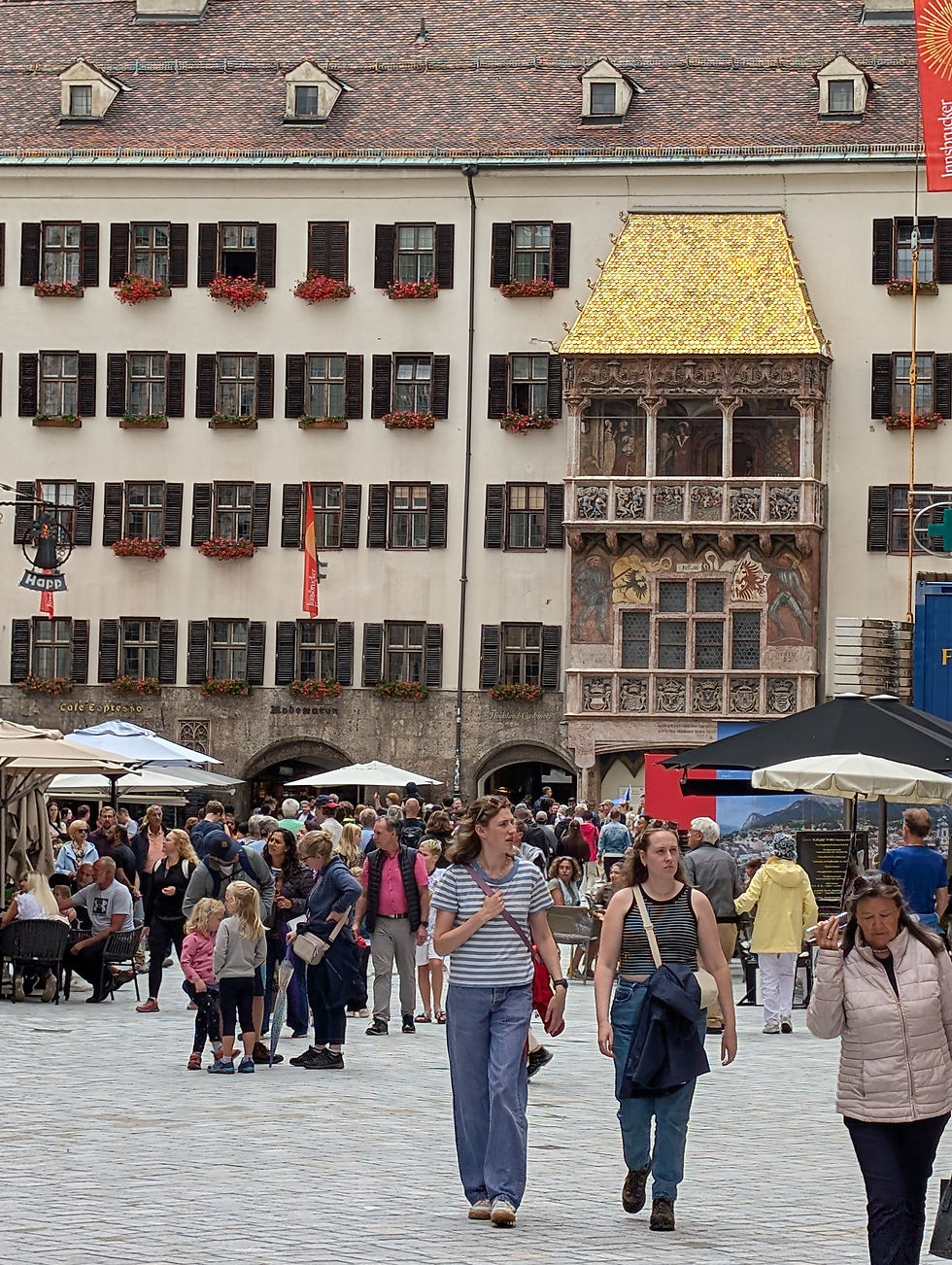
Handsome, imperial and steeped in the history of the Tyrol region of Austria, Innsbruck is also the capital city of the Alps. North lies Germany and Bavaria, over mountainous back country; head East and you’ll come to Salzburg and Mozart; West takes you back to Lichtenstein and Switzerland; less than two hours South, over the Brenner Pass and you’re in the heart of the Italian Dolomites.
A favourite of Holy Roman Emperor, Maximilian I (1459-1514), he saw the city’s political and geographical significance. Under his watch, both the imperial palace and the famous Golden Dachl were built in 1500, the latter to mark his wedding to Bianca Maria Sforza of Milan. With its dazzling roof fretted with 2657 fire-gilded copper tiles presiding over a confluence of streets in the old town, it’s the best spot to linger with an ice-cream and soak up the convivial atmosphere of the city. Then head to local institution, the Stiefkeller, for a brew and a plate of kaiserspatzl (Austrian macaroni cheese). At the table, as rain suddenly hammers down on the wide umbrellas and a benevolent stag party totters around, my son toys with his newly purchased catapult.
‘Be careful with that,’ we say. ‘Remember David and Goliath.’
My son stops to think, pulls the strap taught.
‘But he had God on his side.’
The real local hero, however, the man at the heart of Tyrolean folklore, is Andreas Hofer. A kind of Austrian William Tell, it was Hofer who with his ragtag militia of farmers and carpenters, sick of Bavarian and Napoleonic rule, fought a series of battles in the Innsbruck area in 1809. On a hill south of the city – the Bergisel – the third and most famous of these is depicted in a monumental painting by Munich artist, Michael Zeno Diemer. Having been relocated to a purpose-built museum on the actual site of the battle, the painting is a complete 360 degrees panorama and covers over 1000 square metres of canvas. The viewer emerges from the top of a staircase into the heat of battle. As close as art comes to theatre, the spectator can choose which perspective to take as they perambulate the narrative: the Tyrolean forces pouring down the forested mountainsides, marshalled by a barrel-like Hofer; the desperate Bavarians tearing out of Innsbruck; or beyond it all the mountains, fields and valleys indifferent to the human drama unfolding beneath them. You can pick out individuals charging, dying, swigging a bottle of Dutch courage; one Tyrolean marksman unnervingly points his rife straight at you.

Vying for position on the same hill is that other great icon of Innsbruck: the Bergisel ski jump. There has been a ski jump here since 1924 and twice it played its part in the Winter Olympics of 1964 and 1976. The latest iteration was designed in 2004 by the by British-Iraqi architect, Zaha Hadi, for which she was awarded the Austrian State Architecture Prize. Hovering above the jump itself, the way the wrap-around glass of the panoramic restaurant juts up like a sylvan periscope puts one in mind of a Rebel watch tower on planet Endor’s moon in Star Wars: Return of the Jedi. But it’s real-life skywalkers who train and compete here. Launching themselves from 240m above Innsbruck, those brave athletes who soar through the air above a glittering city, 28000 spectators, and the sobering gravestones of the Friedhof Wilten Cemetery, achieve heroic status. Even Pope John Paul II held a mass here.
For it’s the great outdoors that matters most. We tapped into the local heart of that by staying in Axams, a mountainside village 10km outside of Innsbruck. It was the Austrian way, like Heidi we thought, to descend each morning to buy our bread and milk from the bakery, following the course of a stream as it ran through the village from up on high. Halfway down, just before the earthy smells of farm stables, on a balcony above our heads two little wooden figurines of husband and wife appeared to be driving a miniature windmill. Across the valley and rising above the church spire, the vast cinema of the northern range, which becomes the ennobling backdrop for the everyday. For our daughter's tenth birthday, we made the valley walk from the traditional timbered village of Gortens through the fields of corn and past little wayside shrines to the Lake of Nattersee. This sweet body of water, flanked by a campsite and centred by an inflatable assault course - where children are as adept as their parents are hapless - has the low key charm of halcyon days. The cafe serves up some of the best ice-cream sundaes and apfel strudel in the area.

Our fill of Austrian domesticity acted as a counterweight to the train travel. Home was a ground-floor apartment in a Tyrolean house on a steep hillside, complete with two tiers of wooden balcony: bushy eyebrows above, genial moustache below. We even had a small, elevated swimming pool in the garden covered by a kind of polytunnel, which could be concertinaed back for entry. Each morning, my seven-year-old son took it upon himself to ask the elderly Gerhart, the owner who lived above, in his best newly acquired German: Kannst du das schwimmbad ofen, bitte? The bemused response was always the same: Ja. Genau!
Scenes from the Inn Valley
Early one morning I followed my nose up and up and up, the road giving way to an arrow straight path up the mountain through the forest. The pines were still in shadow, the water in the stream metallic with cold. I met a solitary dog-walker; in that early hour few words were exchanged, a quiet acknowledgement of each other enough. But rising above, a miraculous peak emerged bare in the morning light, like an over-exposed photograph in contrast to the regiments of dark evergreen beneath. Having come out with no map and not much of a clue, this was my beacon. It brought me to Axamer Lizum, a monochrome kind of place, with its hotels closed in summer and intermittent chair lift, that is biding its time for winter. But it is the jumping off point for the gondola that takes you up to the Hoadl House, the local ski station with its distinctive glass visor of a viewing platform, and the end point for what the man in the information office in Axams described proudly as ‘our signature walk.’
This is a magnificent circular hike, one which runs around a plateau and the scree skirts of a huddle of peaks known as the Kalkkogel range, whose ghostly grey and jagged rock is reminiscent of the Dolomites less than a day’s travel to the south. On the day of our attempt, it had rained in the morning, which meant the chairlift from Axamer Lizum to the start of the walk at Birgitzkopflhaus was not running. There and then we made the decision to walk up from the bottom. A climb is always more satisfying, isn’t it? Our children were not convinced. But realising they had little to no choice in the matter, they acquiesced and began the ascent to the Halsl ridge encouraged by regular intervals of almond slice.
We climbed up through a valley of pine and mist, which masked any view from sight, until we reached Halsl at 1992m metres. At this point, windows in the mist offered teasing and fleeting peepholes of rolling back country to the south. We were encouraged and a further ascent in shadow brought us to a saddle upon which lounged a percussive group of brown and white cows. From here we could see down to the plateau proper and the Hochtennbodensteig, the route we were due to take all the way round to the Hoadl House. But it was here that we lost our nerve. Maybe it was the forbidding mists and the promise of rain, or was it in the lonely indifference of the mountains? It may have been the cautious local coming the other way who advised against walking across the screeside path, sections of which had disappeared in the recent rain. The children were getting anxious.
We retreated to the top of the saddle for lunch. Here we found a perfectly appointed picnic table. Commit to a decision, it seemed to say, and Providence moves in your favour. For it was just as we sat down to eat our cheese sandwiches, ignoring the minefield of cow pats, that the sun made his appearance and a keen breeze pulled the mists off the top of the peaks like the hood off a falcon. Directly in front of us, as if for our benefit alone, the tops of the Kalkkogel range were unveiled in succession, from Ampferstein to Hochtennspize to Steingrubenkogel at 2633m. We couldn’t believe our luck. Granite grey summits, sweeping morraines as delicate as crotched doilies, alpine paths as though drawn in chalk. The mood in the camp changed immediately and it was a joyful descent back down to Axamer Lizum; although the same path, it was like returning by a different route.

But if there’s one mountain in which to put your flag, it has to be Nordkette. Towering away to the north, this is Innsbruck’s home mountain, technically within the city limits. This can be climbed on foot from the city centre, or if the family don’t have it in them, you can take a mixture of the engineering marvel that is the Hungarburgbahn funicular railway and the Seegrubenbahn and Hafelekarbahn cable cars right to the Top of Innsbruck as its affectionately known. It’s a remarkable teleportation into high mountain country. There can be few cities in the world where you can go from sipping a downtown Weissbier to summiting a bona fide alpine peak in the space of less than half an hour.
It’s a pretty swell view from two thirds of the way up at Seegrube, with its alfresco terrace and bar looking down to the city far below. We shared a moment of the sublime with a young Hungarian lad working nearby in electronics manafacturing. But it’s the next step which makes the steep price of the ticket worth it. We disembarked from the Hafelekarbahn cable car and stepped immediately into high alpine terrain. Everything was suddenly much colder and the wind whipped around us. At this altitude, even the scrub vegetation has disappeared; the crowds had thinned as well. A climb of less than 15 minutes brought us to the summit itself, marked by a tall simple cross presiding over the city far below.
And, like that, we were at the Top of Innsbruck, Capital of the Alps.

For a while we sat together as a family taking it all in. Then my son asked if he and I could make the scramble up to a daring outcrop behind the summit to the north. I agreed. Taking it slowly by hand and foot, we emerged at the top and then nestled down out of the wind. We shared an apple and took out our notebooks from my rucksack. Below us, I could see my wife and daughter stretched out head-to-head on a bench. I scribbled in my journal, while my son rested his head on my shoulder and drew the scene. I pointed out the different directions: to the west along the Inn Valley our village of Axams, and much further still the Arlberg Pass back to Lichtenstein and Switzerland; to the east Salzberg, Vienna and Hungary; to the south the passage to Italy lay clear over the lofty stilts of the Europe Bridge and on towards the Brenner Pass. Three points of the compass pointed to habitable civilisation.
But it was a formidable prospect to the north. That way lay the wild backcountry of the Karwendel Mountains, whose ragged peaks and jaw-like ridges plunged down to a forested basin, among which a handful of mountain refuges could be seen. It was not for the faint-hearted. And beyond all that: Germany.
I looked down at my son, whose head was still buried in his shading and sketching.
‘Well, what do you reckon?’ I asked him in a mood of sudden spontaneity. Where shall we go tomorrow?’.
He glanced around him before nonchalantly before replying.
‘Germany’.
I took one more look north and shivered. ‘In that case then, I think we’ll take the train.’


Comments